


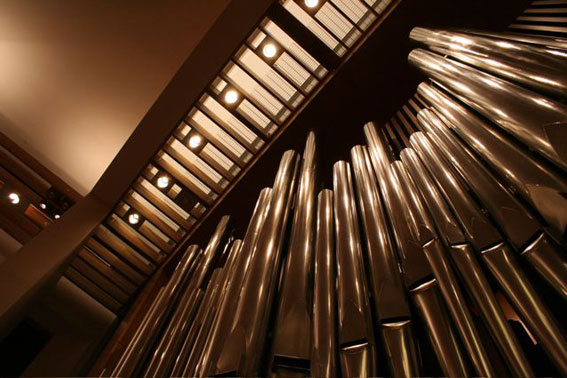
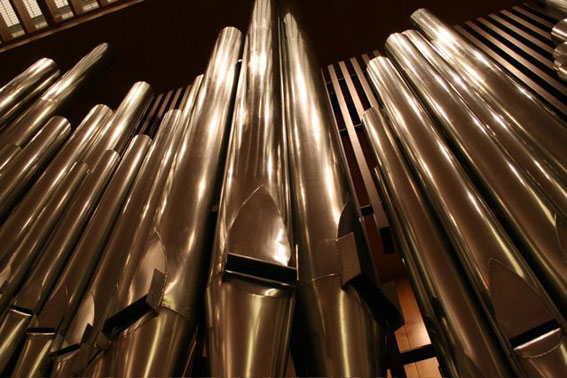
The cathedral is served by two organs. The main cathedral pipe organ was built by Norman & Beard in 1898, and formerly located in St. Saviour’s Anglican Church, Walton, Place, London. The restoration and installation was undertaken in 2002 by Peter D.G. Jewkes Pty Ltd.
This large three manual instrument is noteworthy for the brilliance and cohesiveness of its choruses, which are immense-loud, rather than aggressive-loud, its superb reeds (including the splendid high-pressure Tromba and Swell reed chorus), and the kaleidoscope of tone colours available in the array of flutes and strings.
The Blessed Sacrament Chapel, (formerly the original church) contains a 2 manual Viscount purchased in 2006. The organ is on a platform which can be wheeled into any position in the chapel or cathedral.
Organ Scholarships
Background
St. Patrick’s Cathedral, Parramatta has established a scholarship to assist a young musician in developing skills required of an organist to serve the liturgical life of a busy cathedral church in the heart of western Sydney.
The cathedral serves as the parish church of Parramatta, and has a busy schedule of Sunday liturgies and Solemnities requiring music. The organ is used as the principal instrument for the 6.00pm Vigil Mass, 9.30am Solemn Mass (with Choir), 11.00am and 6.00pm. In addition, there are Weddings on most Saturdays of the year and occasional funerals.
As the church of the Bishop of Parramatta, the cathedral also serves the diocese as the centre for diocesan liturgies, and for services of diocesan agencies, schools and civic occasions.
The cathedral is a striking modern building, designed by Mitchell, Giurgola and Thorp, (architects of Parliament House, Canberra), and houses the magnificent English Cathedral style 3 manual 1898 Norman & Beard Pipe Organ (restored 2003 by Peter Jewkes Pty Ltd), within its lively acoustical space.
Organ Scholar Training
The tradition of Sacred Music in the service of the catholic liturgy is a long and venerable one. Music in the solemn liturgies of the church is integral. The role of the music ministers is therefore an important one, and requires particular and specific skills. Within a cathedral setting, the organ scholar has the opportunity of developing these skills, and applying them by participating in and accompanying designated and diverse cathedral liturgies.
The work of the liturgical music minister offers many rewards. Personal satisfaction in using one’s musical talent in the service of God, the cathedral community and the city; the opportunity of working with other musicians, both amateur and professional; and the opportunity of improving one’s own musicianship and skills to a professional standard.
In offering the scholarship it is envisaged to develop the following:
- Training of Organist’s musical skills
- Development of organist’s liturgical knowledge
- Praxis of Liturgical Music skills -i.e. accompanying the ceremonial of the Roman rite.
- Music administratiion and organisational skills
Duties of the Organ Scholar
- To assist the Director of Music and assistant organists in planning, sourcing, performing music for the catholic liturgy, including accompanying the assembly’s singing of acclamations, hymns and songs at Mass, and in accompanying the cathedral cantors, choirs and other musicians.
- To perform solo organ repertoire such as preludes, reflection music, ceremonial improvisation and postludes as required.
- To take an active role in other cathedral music activities, such as singing in the various choirs, or cantoring duties as may occasionally arise.
- To liaise with the Cathedral Dean, pastoral associate, parish musicians or appointed delegate of the Dean, in determining music program and commitments within the cathedral.
The Scholarship
- Scholarship to be paid in quarterly installments.
- A portion of the scholarship to be paid towards organ tuition and other associated training, e.g. liturgy workshops, tutorial sessions etc. The balance will be paid in cash.
- The organ scholar will have unrestricted access to the cathedral organs for practice and tuition, subject to the availability of the cathedral.
- The scholar must demonstrate satisfactory development and progress in his training.
- The appointment will be for a trial period of 3 months with renewal on demonstration of satisfactory progress.
- The Scholarship will be awarded by a panel consisting of the following persons:
- The Dean,
- The Director of Music,
- A member of Pastoral Council & or/ teacher.
Criteria for Applicants
- The applicant must be a student in Year 10, 11 or 12 or a tertiary place of education.
- It is preferable that the student be Catholic (preferably Latin Rite but members of other rites are welcome to apply e.g. Maronite), or from a Christian background.
- The candidate must have 5th grade or higher AMEB qualification (or equivalent) in piano or organ.
- The candidate must have a good background knowledge of music theory and music history.
- Previous experience with liturgical music, either at school, or parish is desirable, but not essential.
- The candidate must demonstrate commitment in pursuing keyboard studies and developing accompaniment and performance skills to a level appropriate for an organist in public worship.
- The candidate must demonstrate an interest in studying and developing skills in liturgy, and other areas of sacred music, especially in voice – ie cantor or choral music.
- The candidate must be available for the designated Sundays and Solemnities (tba) and all services of Holy Week and Easter.
- Applicants will be required to undertake a basic music audition consisting of aural, sightreading, & practical tests, as well as an interview with the scholarship panel.
Additional Requirements
- Referees – The names and contact details of two referees must be provided
- a priest, a religious brother or sister or lay Religious Studies teacher
- Music teacher
Remuneration and Entitlements
Organ Scholars receive payment for playing at liturgical services, attending rehearsals when required, and also receive lessons from the Cathedral Organist or approved teacher. For information about scholarship payments, contact the Director of Music.
History of the Organs
A Grand Organ for a new Cathedral
The following article is an edited extract from the “History of the Organ”, commissioned by the Diocese of Parramatta in 2023 and written by, Monsignor John Boyle, former Dean of St. Patrick’s Cathedral (1991-2000)
FIRE CHANGES EVERYTHING
<image of building>
In February 1996, an arsonist set fire to the old St Patrick’s Cathedral, Parramatta and it burnt to the ground. The papal Rogers electronic organ, along with the cathedral’s grand piano and the Grand Organ (Holroyd & Edwards 1923, formerly of the Masonic Lodge Sydney) were all destroyed. Rebuilding the cathedral became the priority of the parish and the diocese.
The idea of a pipe organ had not been fully considered until an ‘advertisement’ appeared in April 1997, concerning a redundant organ going for next to nothing in a Church of England parish church in London. Stephen Bicknell, a London organist, and acclaimed author of the 400-page “History of the English Organ”, had posted a note about this instrument being available and was asking, perhaps pleading, for someone to rehouse the historic instrument to avoid its destruction. 1
It was the early days of internet chatrooms and the news of this organ, posted online, on the Piporg List, was picked up by Peter Jewkes, an Australian organ builder. Peter Jewkes contacted Stephen Bicknell in London who replied by fax to his inquiry. This led to a phone conversation with Father Peter Williams, a priest of the Parramatta Diocese, who was studying in Washington DC. Peter Jewkes then made contact with me about a possible new organ for St. Patrick’s. 2
I approached the bishop at that time, Most Rev. Bede Heather, about this pipe organ and a campaign to procure this redundant organ began. There were concerns in some quarters about a traditional pipe organ, due to the perception that more “contemporary” styles of worship music should be pursued. Notwithstanding this, the move to acquire the instrument had been made.
KNIGHTMARE IN KNIGHTSBRIDGE
A “Knightmare in Knightsbridge” internet post relayed a story of how the Anglican community of St Saviour’s, Walton Place, London, was repurposing their mid nineteenth century church. The church is in Walton Place; the other end of Walton Place runs into Harrod’s department store in Knightsbridge. The congregation had aged and dwindled. The area was now gentrified. The developers were about to build two- and three-bedroom units within the structure of the parish’s enormous nineteenth century gothic church. A smaller worship space was to be relocated in the refurbished building.
But there existed in the building an 1840 pipe organ which had been completely rebuilt in 1898 by Messrs Norman and Beard. Only 90 pipes of three large pedal stops remained of the old organ. It was now surplus to the needs of the small congregation. The price was a donation of between £1,000 and £5,000 sterling or nearest offer. Its provenance, recorded in the British Organ Archive in Birmingham, confirmed its authenticity. Stephen Bicknell inspected the organ which had not been used for some years. “With a minor repair, the organ burst into life”, he wrote, “with a glorious flood of traditional organ tone that filled the building with a hearty and bold sound”. 3.
Peter Jewkes asked a London organ builder, Michael Latham, to have a look at this instrument, which he did on May 2, 1997. Latham wrote up a six-page report. “The overall effect is one of some grandeur”, he wrote. 4. I spoke with Peter Jewkes again on May 9, 5. and then telephoned and spoke with the Vicar of St Saviour’s to tell him we were interested. 6.. Sometime later I visited St Saviour’s and met the Vicar and members of the congregation.
THE NEED FOR A SPEEDY DECISION
The Latham report makes note of the speed with which a decision would have to be made regarding removing the instrument from St Saviour’s. He is writing at the beginning of May and work by the developers was scheduled to start in June. He writes, “… so speed is of the essence if damage to the organ is to be avoided.” 7.
BISHOP SAYS TO PROCEED WITH THE PURCHASE OF THE ORGAN
Meanwhile, I was putting pressure on the bishop to make a decision. Concerns about the cost of the organ, shipping, storage and its restoration were in the minds of the administration. Father Peter Williams wrote a two-page communique outlining the importance of a pipe organ for the cathedral with special reference to the Norman and Beard instrument. This letter provided legitimacy in my conversations with the hesitant bishop. 8. Despite the uncertainties, Bishop Bede gave permission for the diocese to purchase the Norman and Beard organ, 9.
An offer of £5,000 was made to St Saviour’s parish at Walton Place. The offer was accepted. The organ was dismantled by the London firm of John Mander Ltd and was loaded into a shipping container which left for the new St. Patrick’s Cathedral on August 15, 1997. 10
When the shipping container arrived in Parramatta, the organ parts were laid out on the top floor of the former Marist Brothers’ school, in the 1918 building. Some of the more massive organ pipes were moved to a printing works factory at Granville, before being moved to Peter Jewkes’ workshop at Ermington for rebuilding. 11.
The following additional information has been provided by Director of Music, Bernard Kirkpatrick
RESTORATION WORK
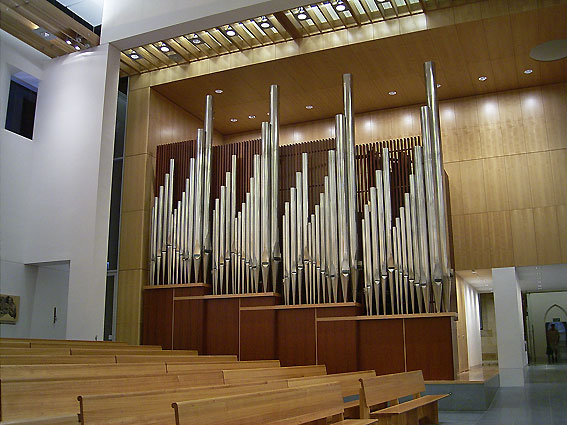
The organ remained in storage for a short time, until restoration work began. Due to the architectural differences between the original neo-gothic church and the modern interior design of the new cathedral, a number of modifications and adjustments were needed in order for the instrument to take its place in the north-western bay of the cathedral. To oversee this process, Dr. Christopher Dearnley (former Organist & Director of Music, St. Paul’s Cathedral, London) was engaged as consultant. Sadly, Dr. Dearnley suddenly died just before the alteration works were to commence. 12. These changes were subsequently placed under the supervision of a new consultant Dr. Kelvin Hastie. Since the organ had previously been situated in a transept and had no case, Stephen Bicknell was again consulted in collaboration with the cathedral architect Romaldo Giurgola, this time to design a case and pipework layout which would suit the new position of the organ.
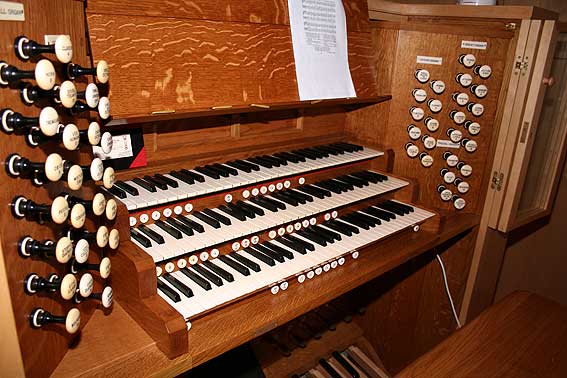
The console of the original organ had also been previously located within the organ itself. Due to space constraints, the electro-pneumatic mechanism was abandoned in favour of a new electric action, which enabled the console to be detached from the organ and placed on the south-west platform of the choir area. The original console keyboards and stops were retained in a new console case. A new computerised system was installed which also allowed for a 96-channel memory to be added.
The organ was finally completed and installed in the cathedral in 2005.
The opening recital was performed by Mr. David Drury.
UPGRADES
In 2013, the cathedral celebrated its 10th anniversary of dedication. As part of the anniversary celebrations, the bishop at the time, Most Rev. Anthony Fisher approached the Director of Music, Bernard Kirkpatrick and asked if there was anything which could be done to further enhance the organ. The opportunity was taken to make a number of additions to the stop-list. These included the addition of three digital stops (space constraints prevented “real” organ pipes from being added), a 16’ Major Bass, 32’ Double Open Wood and 32’ Contra-Ophicleide. A “Swell Reeds to Pedal” switching stop was also added. The addition of these extra stops has greatly enhanced the tonal spectrum and flexibility of the instrument.
1. Bicknell, Stephen, “Knightmare in Knightsbridge”, communication to a pipe organ chat group, April 17, 1997.
2. Boyle, Very Rev John, Editorial, St Patrick’s Parish Bulletin, St Patrick’s Parish, Parramatta, Archives, May 3, 1998.
3. Bicknell, Stephen, “Knightmare in Knightsbridge”, communication to the pip e organ chat group, April 17, 1997, page 4.
4. Latham, Michael, Organ builder, to Peter Jewkes, Fax, May 04,1997, page 3.
5. Boyle, Very Rev John, Fax to Father Peter Williams, May 12, 1997.
6. Williams, Rev Peter, Letter to Very Rev John Boyle, May 18,1997.
7. Latham, Michael, Organ builder, Fax to Peter Jewkes, May 04,1997, page 5.
8. Williams, Peter, Letter to Very Rev John Boyle, May 9,1997.
9. fax dated May 30. Jewkes, Valmai, to Les Ross of Mander Ltd, May 30, 1997.
10. Ross, Les [N P Mander Ltd, pipe organ builder’s foreman] Fax to Peter Jewkes, August 15, 1997.
11. Conversation with Peter Jewkes, May 10, 2023
12. Conversation with Rev. Peter Williams 19 October 2023
Photo of St. Saviour’s Walton Place courtesy John Salmon